
Traditional paint does two things: it adds color and provides a basic layer of protection. But the next generation of coatings—Smart Paints—is far more ambitious. These materials are engineered to respond dynamically to their environment, effectively “thinking” and reacting to damage or temperature changes.
Here is an exploration of the two most exciting frontiers in coating technology: Self-Healing Coatings and Heat-Sensitive Pigments.
1. Self-Healing Coatings: The Paint That Repairs Itself
Imagine a car scratch that vanishes overnight or a bridge coating that fixes its own cracks before rust can set in. Self-healing coatings mimic biological systems (like skin) to autonomously repair physical damage.
How it Works
There are two primary methods used to achieve this “healing” effect:
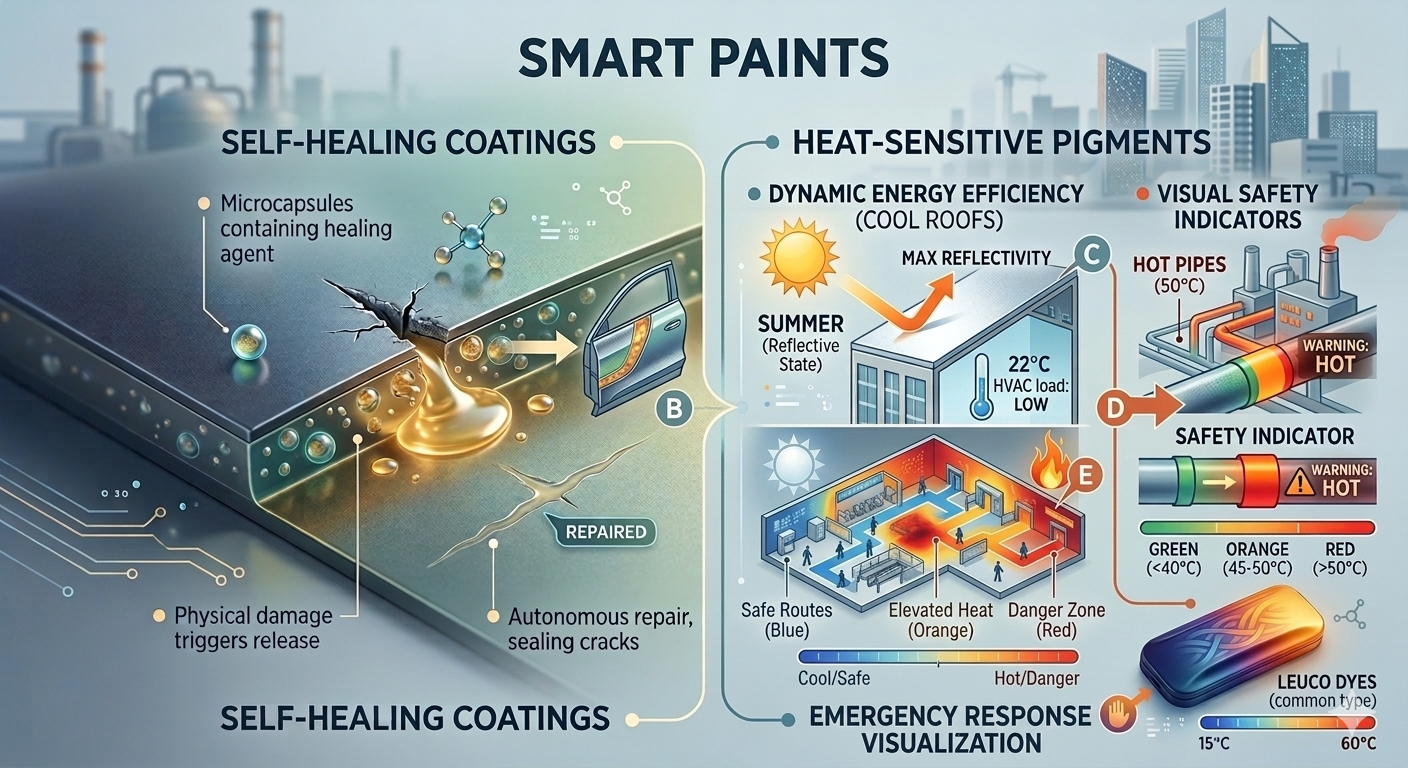
- Microencapsulation: Tiny capsules filled with a liquid healing agent (like epoxy or resin) are mixed into the paint. When the paint is scratched, the capsules rupture, releasing the “glue” into the crack. It then hardens, sealing the wound.
- Vascular Networks: Similar to veins in a leaf, a network of microscopic capillaries runs through the coating. If damage occurs, the network pumps healing agents to the site, allowing for multiple repairs in the same spot.
- Shape Memory Polymers: These coatings use heat or UV light to “remember” their original flat shape. When scratched, applying a bit of warmth causes the polymer chains to reorganize and smooth over the blemish.
Why It’s a Game Changer
- Corrosion Prevention: By sealing cracks instantly, moisture never reaches the metal underneath.
- Sustainability: Products last longer, reducing the need for stripping and repainting.
- Reduced Maintenance: Ideal for hard-to-reach structures like offshore wind turbines or aerospace components.
2. Heat-Sensitive Pigments: Color with a Purpose
Commonly known as Thermochromic Coatings, these paints change color based on temperature. While they might remind you of 90s mood rings, their modern applications are deeply practical and energy-efficient.
The Two Main Types
- Leuco Dyes: These are the most common. They transition from colored to transparent at a specific temperature (the “switching point”).
- Liquid Crystals: These are more precise and can display a full spectrum of colors as temperature shifts, though they are often more fragile and expensive.
Practical Applications
- Energy Efficiency (Cool Roofs): Imagine a roof that turns white in the summer to reflect sunlight and dark in the winter to absorb heat. This “dynamic insulation” can drastically reduce HVAC costs.
- Safety Indicators: Smart paint on industrial pipes can turn bright red if a surface is dangerously hot to the touch, providing a visual warning for workers.
- Food Packaging: Thermochromic labels can tell you if a product has been “temperature-abused” during shipping (e.g., if milk stayed in a warm truck too long).
The Intersection: Smart Cities and Beyond
The goal of Smart Paint isn’t just aesthetics; it’s about creating a “Responsive Infrastructure.” When we combine self-healing properties with heat-sensitive technology, we get materials that are:
- Proactive: Identifying and fixing problems before they become structural failures.
- Interactive: Communicating data (like temperature or stress levels) through color.
- Autonomous: Reducing the human labor required to maintain the built world.
Fun Fact: Some experimental smart paints are now being infused with Piezoelectric materials, which could theoretically turn your entire house into a giant sensor or even a low-grade energy harvester just by feeling the vibrations of the wind.
Leave a Reply