

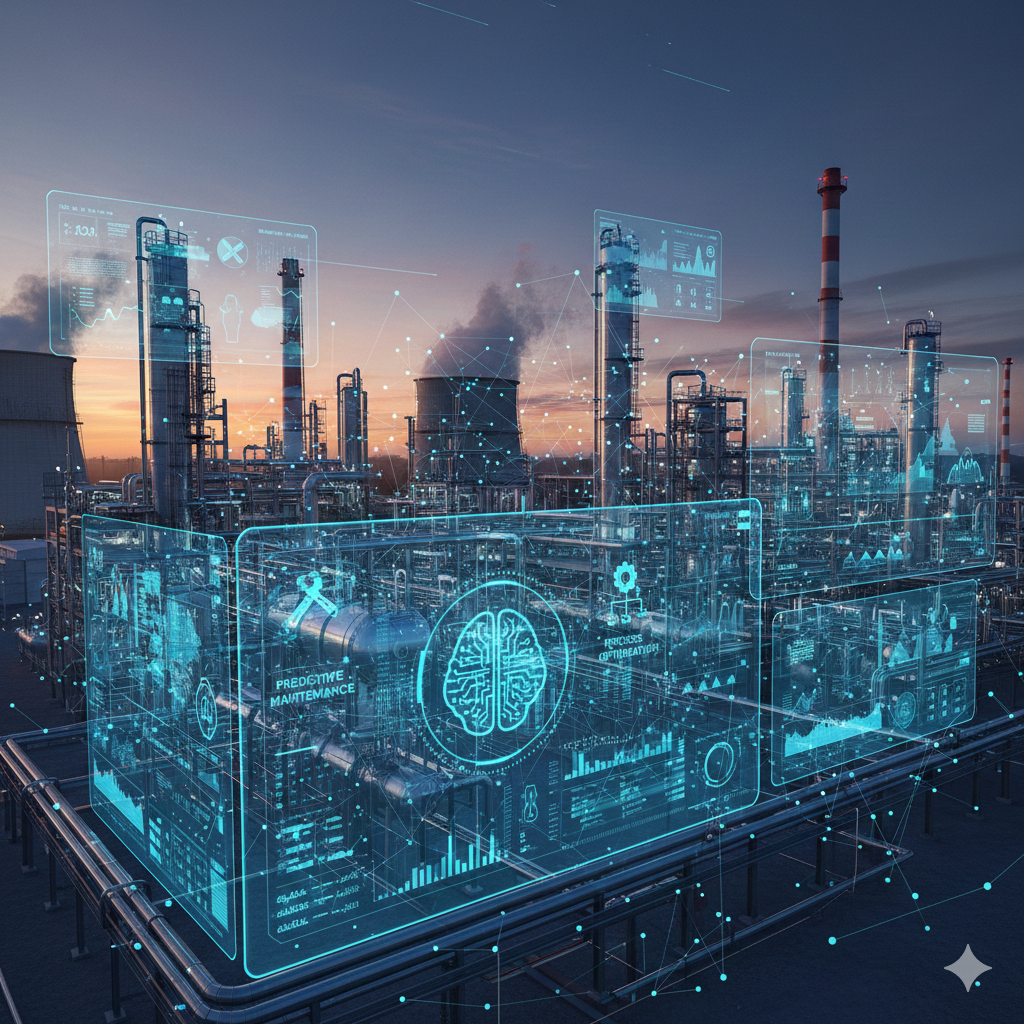
The chemical manufacturing industry is undergoing a profound transformation, driven by advancements in the Internet of Things (IoT) and Artificial Intelligence (AI). At the heart of this revolution liesthe concept of Digital Twins, virtual replicas of physical assets, processes, or systems. By integrating real-time data from IoT sensors with sophisticated AI algorithms, digital twins offer unprecedented insights, enabling predictive maintenance, optimizing processes, and ultimately driving efficiency and profitability.

What is a Digital Twin?
A digital twin is more than just a 3D model. It’s a dynamic, virtual representation that continuously mirrors its physical counterpart. This connection is established through:
- IoT Sensors: Collecting real-time data on temperature, pressure, flow rates, vibration, chemical composition, and more.
- Data Integration: Feeding this data into the digital model.
- AI and Machine Learning: Analyzing the data, identifying patterns, predicting future behavior, and simulating various scenarios.
In chemical manufacturing, a digital twin can represent anything from a single pump or reactor to an entire production line or even a whole plant.
The Power of Predictive Maintenance
One of the most significant benefits of digital twins in chemical manufacturing is the shift from reactive or preventive maintenance to predictive maintenance.
- Traditional Maintenance:
- Reactive: Repairing equipment after it breaks down, leading to costly downtime and potential safety hazards.
- Preventive: Performing maintenance at fixed intervals, often resulting in unnecessary maintenance or missed impending failures.
- Digital Twin-Enabled Predictive Maintenance:
- Real-time Monitoring: Digital twins continuously monitor the health and performance of equipment using IoT data.
- Anomaly Detection: AI algorithms identify subtle deviations from normal operating conditions, signaling potential issues before they escalate.
- Failure Prediction: Machine learning models predict when a component is likely to fail, allowing maintenance to be scheduled precisely when needed.
- Optimized Scheduling: Maintenance tasks can be planned during scheduled downtimes, minimizing disruption to production.
- Reduced Costs: Lower downtime, fewer catastrophic failures, and optimized spare parts inventory all contribute to significant cost savings.
Enhancing Process Optimization
Beyond maintenance, digital twins are powerful tools for optimizing complex chemical processes.
- Real-time Process Monitoring: Operators gain a comprehensive, up-to-the-minute view of their entire production process.
- Simulation and “What-If” Scenarios: Digital twins allow engineers to simulate changes to process parameters without affecting the physical plant. This enables:
- Testing new formulations or catalysts.
- Optimizing reaction conditions for yield and purity.
- Evaluating the impact of different raw materials.
- Identifying bottlenecks and inefficiencies.
- Energy Efficiency: By simulating various operating conditions, companies can identify optimal settings to reduce energy consumption.
- Quality Control: Digital twins can predict product quality based on process parameters, allowing for real-time adjustments to maintain specifications and reduce off-spec batches.
- Safety Enhancements: Simulating hazardous scenarios and emergency procedures in a virtual environment improves operator training and plant safety protocols.
Key Components for Implementing Digital Twins
Successful implementation of digital twins relies on several critical technological pillars:
- Robust IoT Infrastructure: A network of reliable sensors, gateways, and communication protocols to collect vast amounts of data.
- High-Performance Computing: The computational power to process and analyze real-time data from numerous sources.
- Advanced Analytics and AI Platforms: Machine learning, deep learning, and predictive modeling algorithms to derive insights from data.
- Secure Data Management: Robust systems for storing, managing, and securing sensitive operational data.
- Visualization Tools: Intuitive dashboards and interfaces to present complex data and insights to operators and decision-makers.
- Integration Capabilities: Seamless integration with existing SCADA, MES, and ERP systems.
The Future of Chemical Manufacturing
Digital twins are not just a technological trend; they represent a fundamental shift in how chemical manufacturing plants are designed, operated, and maintained. By providing a living, breathing virtual replica of the physical world, they empower businesses to:
- Make data-driven decisions with greater confidence.
- Achieve higher levels of operational efficiency and agility.
- Enhance safety and environmental performance.
- Innovate faster and bring new products to market more quickly.
As IoT and AI technologies continue to mature, digital twins will become an indispensable asset for chemical manufacturers striving for competitive advantage in an increasingly complex and demanding global market.
Leave a Reply