

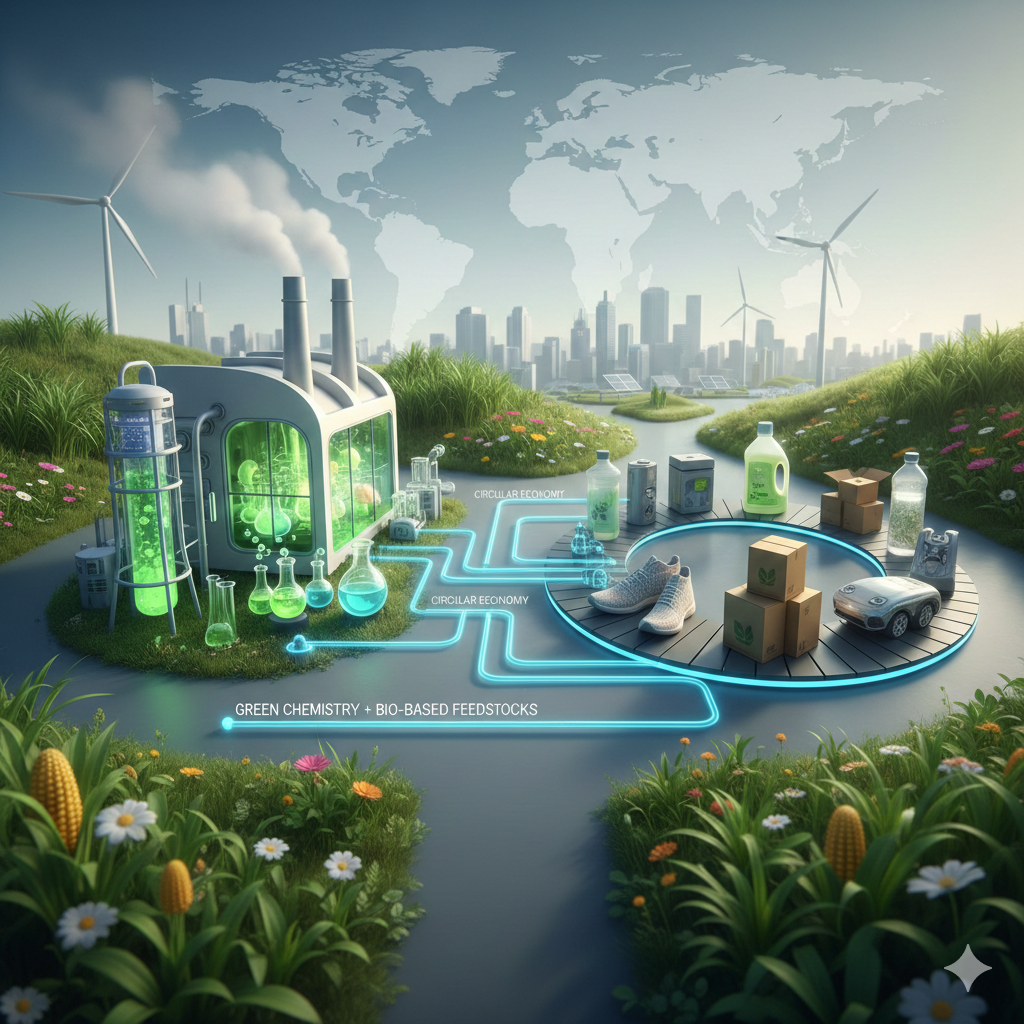
The world is facing an urgent need to transition from a linear “take-make-dispose” economy to a circular one. This shift is crucial for addressing climate change, resource depletion, and pollution. At the heart of this transformation lies the imperative to replace fossil fuels with sustainable alternatives in industrial production. Green chemistry and bio-based feedstocks are emerging as powerful drivers in this paradigm shift, paving the way for a more sustainable future.
The Urgency of the Circular Economy
Our current economic model relies heavily on finite resources and generates massive amounts of waste. This linear approach has led to:
- Climate Change: The combustion of fossil fuels releases greenhouse gases, accelerating global warming.
- Resource Depletion: Many essential raw materials are being consumed at unsustainable rates.
- Environmental Pollution: Waste generation, often containing hazardous substances, contaminates our land, air, and water.
The circular economy offers a solution by focusing on designing out waste and pollution, keeping products and materials in use, and regenerating natural systems.
Green Chemistry: Designing for Sustainability
Green chemistry is a philosophy and practice that focuses on designing chemical products and processes that reduce or eliminate the use and generation of hazardous substances. It’s a fundamental pillar of the circular economy, enabling industries to minimize their environmental footprint from the very beginning of a product’s lifecycle.
Key Principles of Green Chemistry:
- Prevention: It’s better to prevent waste than to treat or clean up waste after it has been created.
- Atom Economy: Synthetic methods should be designed to maximize the incorporation of all materials used in the process into the final product.
- Less Hazardous Chemical Syntheses: Wherever practicable, synthetic methods should be designed to use and generate substances that possess little or no toxicity to human health and the environment.
- Designing Safer Chemicals: Chemical products should be designed to preserve efficacy of function while reducing toxicity.
- Safer Solvents and Auxiliaries: The use of auxiliary substances (e.g., solvents, separation agents) should be made unnecessary wherever possible and, when used, innocuous.
- Design for Energy Efficiency: Energy requirements of chemical processes should be recognized for their environmental and economic impacts and should be minimized.
- Use of Renewable Feedstocks: A raw material or feedstock should be renewable rather than depleting whenever technically and economically practicable.
- Reduce Derivatives: Unnecessary derivatization (use of blocking groups, protection/de-protection, temporary modification of physical/chemical processes) should be minimized or avoided if possible, because such steps require additional reagents and can generate waste.
- Catalysis: Catalytic reagents (as selective as possible) are superior to stoichiometric reagents.
- Design for Degradation: Chemical products should be designed so that at the end of their function they break down into innocuous degradation products and do not persist in the environment.
- Real-time Analysis for Pollution Prevention: Analytical methodologies need to be further developed to allow for real-time, in-process monitoring and control prior to the formation of hazardous substances.
- Inherently Safer Chemistry for Accident Prevention: Substances and the form of a substance used in a chemical process should be chosen to minimize the potential for chemical accidents, including releases, explosions, and fires.
Bio-Based Feedstocks: Nature’s Building Blocks
Bio-based feedstocks are materials derived from renewable biological resources, such as plants, algae, and agricultural waste. These feedstocks offer a sustainable alternative to fossil fuels as raw materials for a wide range of industrial products, from plastics and textiles to fuels and chemicals.
Advantages of Bio-Based Feedstocks:
- Renewable: Unlike fossil fuels, bio-based feedstocks can be continuously replenished through natural cycles.
- Reduced Carbon Footprint: Growing plants absorb carbon dioxide from the atmosphere, helping to offset emissions from their processing and use.
- Biodegradability: Many bio-based materials are biodegradable, reducing landfill waste and environmental persistence.
- Diversification of Resources: Reducing reliance on volatile fossil fuel markets.
- Rural Economic Development: Creating new markets for agricultural products and supporting rural economies.
The Synergy of Green Chemistry and Bio-Based Feedstocks
The true power of this transition lies in the synergistic application of green chemistry principles with bio-based feedstocks.
- Sustainable Biorefineries: Green chemistry principles are essential for designing efficient and environmentally friendly processes to convert biomass into valuable products.
- Bio-Based Polymers: Developing plastics from renewable resources that are also designed for recyclability or biodegradability, reducing plastic pollution.
- Renewable Chemicals: Producing essential chemicals for various industries (e.g., solvents, adhesives, pharmaceuticals) from biological sources using green chemical routes.
- Circular Bioeconomy: Creating closed-loop systems where waste from one process becomes a feedstock for another, maximizing resource utilization.
Industries Leading the Way
Several industries are actively embracing green chemistry and bio-based feedstocks:
- Packaging: Developing biodegradable and compostable packaging materials from plant-based sources.
- Textiles: Producing fabrics from renewable fibers like organic cotton, hemp, and innovative bio-based polymers.
- Automotive: Using bio-based plastics and composites in vehicle manufacturing to reduce weight and carbon footprint.
- Chemicals: Shifting from petroleum-derived chemicals to those made from biomass, often through enzymatic or catalytic processes.
- Energy: Advancements in biofuels and bioenergy production from sustainable biomass sources.
Challenges and the Road Ahead
While promising, the transition is not without its challenges:
- Scalability: Ramping up production of bio-based materials to meet global demand.
- Cost Competitiveness: Ensuring that bio-based products can compete with established fossil fuel-derived alternatives.
- Land Use: Balancing the demand for bio-based feedstocks with food production and biodiversity conservation.
- Infrastructure: Developing the necessary infrastructure for collecting, processing, and distributing bio-based materials.
Despite these hurdles, continuous innovation, supportive policies, and increasing consumer demand for sustainable products are driving significant progress. The future of industrial production lies in a harmonious blend of green chemistry and bio-based feedstocks, forging a path towards a truly circular and sustainable economy.
Leave a Reply